
The Secret to Ansarullah’s Victory Over Saudi Mercenaries
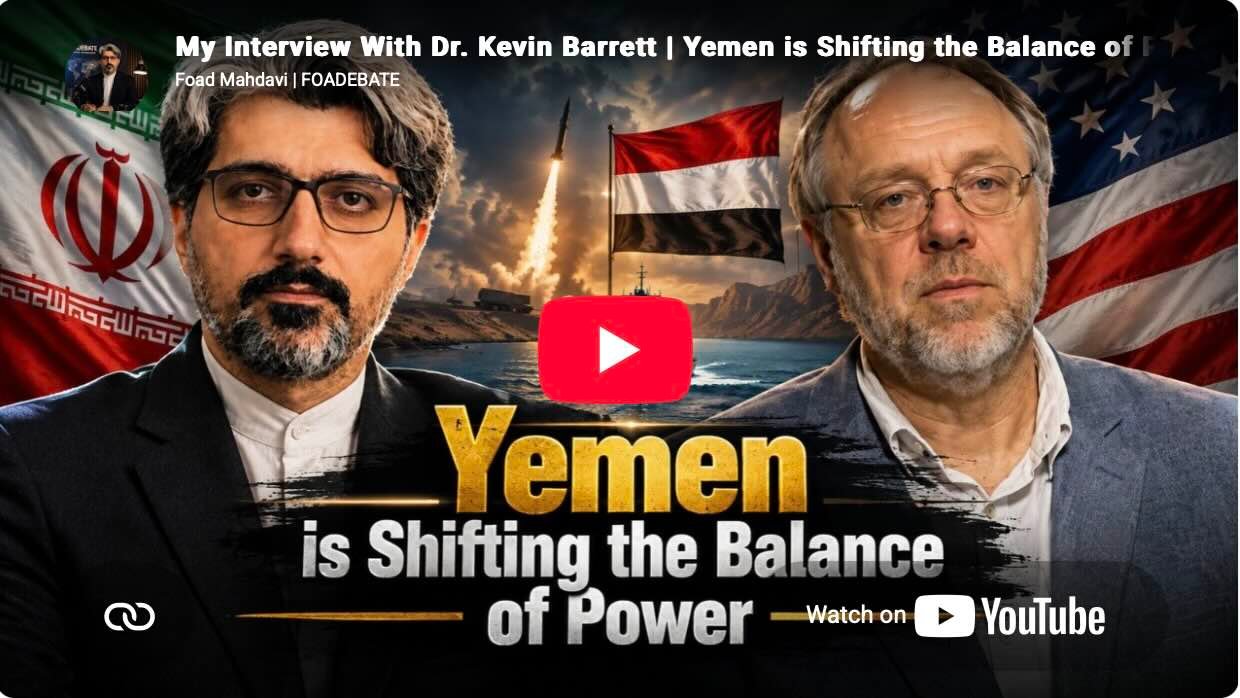
Watch the video or listen to the audio at my Substack
Foad Mahdavi interviewed me on recent developments in Yemen. Above is the audio and video, and below is his post, followed by a transcript. -KB
Professor Kevin Barrett: ”Yemen is a fulcrum, and the balance of power across the entire region is shifting because of it.”
🌐 I spoke with Dr. Kevin Barrett, a prominent American scholar of Islam and geopolitical analyst, about the developments in Yemen and its role in reshaping regional and global power dynamics. Barrett offers a unique perspective on Yemen—a land that is no longer a forgotten footnote on the Arabian Peninsula, but has instead become a decisive fulcrum in the Red Sea and across West Asia. Pointing to Ansarullah’s control over the strategic Bab al-Mandab Strait and the collapse of Saudi positioning, Barrett traces the roots of this astonishing victory not merely to weaponry, but to “Asabiyyah” (social cohesion) and popular solidarity—as conceptualized by Ibn Khaldun—pitted against demoralized mercenary armies. Despite billions of dollars in American weapons, these forces lack the will and motivation to fight; his analysis reveals how human will and faith triumph over the modern war machine.
🔻In this conversation, detailing Iran’s asymmetric warfare strategy, he emphasizes that Yemen is by no means an Iranian proxy, but rather an independent, freedom-seeking ally. In fact, Iran and Yemen are two independent actors working toward a common goal. On a broader level, Barrett analyzes the emergence of a multipolar world order centered around Russia and China, set against the backdrop of the failure of US strategy in the region.
▶ To watch the full interview and gain a deeper understanding of this issue, check out the video and share your valuable insights.
@foadebate | Conversation About Tomorrow’s World
Transcript
Foad Mahdavi: In the name of God, the Compassionate, the Merciful, hello everybody, hope you are doing great, welcome back to Fouadebate. For years, Yemen was treated as a footnote, a poor remote country on the southern edge of the Arabian Peninsula, written off as a proxy battlefield in someone else’s war. But look at the map today. Look at the Red Sea. Look at the headlines. Yemen is no longer a footnote. I’m sorry. It is a fulcrum. And the balance of power in the entire region is shifting because of it.
To help us unpack this, I’m honored to be joined by Dr. Kevin Barrett, an Arabist Islamologist, a former professor at universities in San Francisco, Paris, and Wisconsin, and one of America’s most prominent critics of the war on terror. He’s the host of Truth Jihad Radio, and False Flag Weekly News, and he has written and spoken extensively on the Middle East, Yemen, and the geopolitics of Thank you so much, Dr. Barrett, for being with us today.
Kevin Barrett: Thank you, Foad. It’s good to be back with you. You’re doing great work.
Foad Mahdavi: You’re welcome. Dr. Barrett, let’s get started with the most striking developments. In a matter of days, Yemeni forces under Ansar Allah command captured Muqa and strategic highlands overlooking the Bab al-Mandaab Strait. They now control Yemen’s entire Red Sea coastline. Just how significant is this military transformation?
Kevin Barrett: It’s extremely important. It currently actually shifts the balance of power in the ongoing war between the Israeli-occupied United States and Iran and its allies. Between the destruction of the east-west pipeline, bringing Saudi oil to be shipped out through the Red Sea, and now the Ansarullah control over the Bab al-Mandeb, this basically doubles the pressure on the United States and its erstwhile allies or vassal states in the region who have now even less reason to trust American promises of protection. So that’s the best case scenario for the Americans, that it will be limited at this doubling of pressure on them.
But in fact, it actually promises even more. Ansarullah forces have routed the Saudi mercenaries, showing that a real nation with a real history of civilization—and this is the real civilization of the Arabian Peninsula going back thousands of years—can defeat this gang of Bedouin warlords.
The Ibn Sauds made an alliance with the Wahhabis to set up the ancestor of the current regime in Saudi Arabia that’s misruling the Islamic holy places. And so now the whole balance of power in the Arabian Peninsula is in play, and we could see even more radical changes in the region than most of us had anticipated.
Foad Mahdavi: Right. And yet the Saudi-led coalition has spent hundreds of billions of dollars on American weapons, F-15s, Patriots, the whole arsenal. How does a movement that was once seen as a ragtag militia achieve this?
Kevin Barrett: That’s a fascinating question. I think one answer is that the Western media, which dominates global perceptions, has misportrayed Yemen as a kind of a civilizational backwater where everybody is addicted to chewing khat. We’ve gotten a picture of Yemen that’s very, very impoverished. And in fact, it’s true that Yemen has faced huge challenges, especially after the genocidal Saudi war and blockade that started a decade ago. But the Yemeni civilization is, as I said, the true Arabian civilization. And it is being revived even now against the Saudis.
And I think this illustrates The Ibn Khaldun theory of asabiya being crucially important in determining the outcome of historical struggles. Ibn Khaldun said that city dwellers, wealthy emperors and upper classes in the cities, become basically spoiled. They become too comfortable. They become pampered. And they lose any interest in anything other than individual personal power, pleasure, and comfort.
And that ruins their ability to defend themselves or to get anything done. Whereas outside the imperial power penter, there’s still some kind of asabia or a feeling of belonging to a group. And here we see not only the Ansarullah forces having this ancient Yemeni civilization bringing them together, they have the nucleus of this group, not all of the Yemen government, but the people who are allied with Ansarullah have a nucleus that has a particular religious school of thought associated with it. And that gives them asabiyah as well. And then finally, they are Muslim and in alliance with forces who are struggling to free the entire Islamic world. And Islam, of course, came to largely replace other tribal affiliations, to create a kind of a mega-tribe or a group of people with asabiya who are dedicated to truth and justice. And that’s what the Ansarullah forces represent. Whereas the Ibn Saud forces represent gangster warlords who are only interested in wealth, power, and pleasure. And that’s why they can’t muster any of their people to fight to defend them. Whereas Ansarullah can muster these huge crowds of millions that gather to call for the liberation of the Islamic world in general and, of course, the Al-Aqsa Mosque and occupied Palestine in particular.
Foad Mahdavi: This is actually the classic asymmetric warfare story, right? Firepower doesn’t equal victory, indeed.
Kevin Barrett: Exactly, right. Firepower is not helpful if you have no morale, if you have nobody who is courageous enough and competent enough to want to risk their lives to operate all of your weaponry. And that’s the problem the Saudis have long faced. They have never really been very popular, though there’s a big Western media campaign now trying to tell us that there are young people who are very Westernized or West-toxicated who love Bin Salman because he lets them go to the nightclubs.
But I don’t think the Saudis have managed to solve that problem. They’ve always had to bring in others. They had to bring in the French to chase religious extremists out of Mecca several decades ago. They’ve repeatedly relied on outsiders to defend themselves, and now their reliance on the American empire to defend them and on being obsequious with the Zionist genocide perpetrators, hoping that that will defend them, it’s not working. And so they’re finding themselves defenseless in the face of what was supposed to be a much weaker force. But as they’re finding out, it isn’t so weak.
Foad Mahdavi: Right. Let’s talk about Bab al-Mandab specifically. This is a strait that connects the Gulf of Aden to the Red Sea and from there to the Suez Canal. Something like 12% of global trade passes through it, if I’m not mistaken. Why does control of this waterway matter so much?
Kevin Barrett: Well, geographically, the Bab al-Mandab is the gateway to bypassing having to go around the Horn of Africa to have commerce between the Atlantic Ocean and East Asia, and even Central Asia. And so the sea journeys are vastly longer if they can’t use the Red Sea passageway and the Suez Canal. And so that’s why in the past the Suez Canal has been such a flashpoint. For example, in the Suez Crisis in the 1950s, when the British and the French were trying to support the Israelis in depriving Egypt of control of Suez, that didn’t work out so well for the Zionists and their friends. And this won’t either because again, Ansarullah has the ability now to exert as much pressure as they want over Babel Mendeb. And with modern weaponry it’s very difficult for anyone to come in and try to open up these kinds of waterways, because the land-based forces are able to threaten shipping from great distances using modern missile and drone technology, as Iran has shown us, to Trump’s displeasure, regarding the Persian Gulf.
Foad Mahdavi: Exactly. I have a critical question right now. As you know, the United States has a massive naval presence in the region. Why hasn’t Washington been able to reopen this trade or product shipping?
Kevin Barrett: Well, again, this is the result of the brilliant use of asymmetrical warfare by Iran and the great foresight of Iran’s leaders, including the martyred Imam Khamenei. During his tenure, the Iranian strategists realized that they could leverage the power of geography to defeat a supposedly vastly more powerful empire. And to do that, they realized that well protected assets, assets such as drones and missiles in particular, very deep underground would be very, very difficult to destroy. Whereas they saw that their opponent, their prospective enemy, had bases and was leaving its military assets right out in the open, where they could be targeted by these protected drones and missiles.
So that was a major factor. And another is that very drone and missile technology.
Foad Mahdavi: Dr. Barrett, let’s zoom out. You have written extensively about the Saudi-Emirati rivalry in Yemen. How has that internal coalition factor affected the broader balance of power?
Kevin Barrett: This has been a case in which the forces of the Axis of Resistance and everyone who supports them, that is people who are trying to support the liberation of the Islamic world of West Asia and specifically of Palestine, have not had to work very hard to divide and conquer their opponent. Because the Saudis and the Emiratis…these dynasties have to go out and hire mercenaries. And so what you end up with is these two rival gangs of mercenaries who are mostly interested in their own power and personal profit. And therefore, they’re as much at odds with each other as they are with Ansarullah. And for that reason, we’ve seen all kinds of issues arise on that side. I think the Emiratis have been even more irresponsible than the Saudis. They’ve been sending their mercenaries all over the world, or all over Africa anyway, stirring up trouble and fighting purely for profit. And ultimately, military conflict requires courage. It requires people who are willing to take risks and to suffer and risk being martyred. And these people who are really not living very much in conformance with the spirit, much less the letter of Islam, don’t really feel like if they die, they won’t feel like they died in a good cause. They know that they’re fighting only for money and for personal power and profit. And that removes their courage and their real dedication to fight. And so they just want to grab as much money as they can and get out alive.
And so we see these warlords feuding with each other. And that has, of course, allowed Ansar Allah, who have that asabiyah, and have that dedication to fight fi sabil Allah, and endure martyrdom, if necessary, have a huge advantage.
Foad Mahdavi: Great. Actually, the coalition that went to war together is now competing for influence over the outcome. And where does Iran fit into this? Yemen is often described as an Iranian proxy. Is that accurate?
Kevin Barrett: No, it’s not. In fact, I even had to correct one of the best-informed American commentators, Ron Unz, who’s my editor and publisher at the Unz Review website, who wrote in an otherwise excellent articleabout this very issue, that the Ansarullah movement, I forget exactly how he phrased it, but he basically said that they were Iranian allies out of Shia solidarity. And that’s actually not the case, because the two schools of thought in 12er Shia Islam and Zaidi Islam are very different. And indeed, many analysts would argue that the Ansarullah’s religious approach is about equidistant between the 12er Shia interpretation that is the majoritarian in Iran and the four schools of Sunni Islam. So it’s not an Islamic thing where people of exactly the same religious interpretation are allied. And it’s certainly, the Ansarullah forces are not proxies who are taking orders from Tehran by any means. Anyone who knows anything about them knows that they are quite spirited and independent. And they have their own reasons for wanting to liberate the Muslim world from Zionist genocide and American imperial occupation. And because that’s their cause, they find that Iran is the obvious ally in the region, because who else are they going to ally with if they want to liberate Palestine and liberate the region from American imperialism? So it’s not exactly religious solidarity and it’s not a proxy relationship. What it is, is that both the leadership in Tehran and the leadership in Yemen, are both, from their own different perspectives, dedicated to liberating West Asia and Palestine. And so they work together. But that doesn’t mean that anybody is giving orders to both groups at once. No, it’s two independent actors working together for a common cause.
Foad Mahdavi: Let’s jump to the global standoff and the path forward. As you know, China has condemned the U.S. approach to Yemen and continues to trade with Iran. Russia has also chimed in. Where does this leave the global order? Is Yemen becoming a test case for a multipolar world?
Kevin Barrett: Yeah, absolutely. That’s right. Russia and China are both in their own ways resisting pressures from the American, what we could call it, the Epstein-class empire, the Zionist-occupied American empire, the oligarch-dominated American empire, however you want to phrase it, the American empire realizes it’s facing severe contraction in its relative power globally.
And there are elements of it that just can’t accept that. And they insist on lashing out and desperately seeking a way to establish total global rule. And, of course, that threatens Russia and China. The American desire to put American first-strike missiles right up against Russia’s border with a rabidly Russophobic U.S.-allied Ukraine pointing a gun to Russia’s head, that’s unacceptable to Russia, because it threatens the dissolution of Russia and then the plundering of its mineral wealth. So that’s what Russia is fighting against. And China is resisting a similar push in which the West wants to use Taiwan as a springboard to maintain its dominance over China, not to mention all of these other military bases that they have surrounding China. So both Russia and China are pushing back against this U.S. threat to try to maintain the unipolar world order and perhaps even consolidate it. And so when they look at what’s going on in West Asia, it’s very much in their interest to see the U.S. driven out of West Asia. And they are undoubtedly doing much more to try to accomplish that than meets the eye, because they If they announce that they’re doing something publicly, then it’s going to, of course, stir up the hornet’s nest in Washington.
So I think we can assume that Russia and China are very much on board with this program to change West Asia and to remove it from the sphere of American military occupation.
Foad Mahdavi: Actually, China and Russia are watching and positioning themselves.
Kevin Barrett: Indeed, indeed. They’re acting carefully. They’re not making loud speeches, but they are very much positioning themselves to benefit from the multipolar world that will be emerging in much stronger form from the results of this war.
Foad Mahdavi: Fantastic. At the end, if you were advising policymakers in Washington right now, what would you tell them? What is the lesson of Yemen?
Kevin Barrett: I would tell them that they’ve made a terrible mistake by not following the advice of people like Flint and Hillary Leverett, the Iran experts in the American government, who were driven out of their position because they told the truth. They wrote the book Going to Tehran, and they, following the thought of even people like Zbigniew Brzezinski, recognized that maintaining cordial relations with Iran would be absolutely crucial for the United States to gradually unwind its world domination in a peaceful way that doesn’t threaten its interests, as opposed to crashing and burning and going off the cliff, which is what it’s doing now.
And so I would argue, I would tell them, “you’ve made a terrible mistake. You’ve let yourself be hijacked by the Israelis and marched into an absolutely hopeless situation. You need to change your approach radically and commit to a peaceful, win-win, multipolar world.”
Now, that would be hopeless advice for me to be giving to people around Trump, because they are all narcissistic, basically ignorant people who believe that through beating their chests and being very, very, very vainglorious and launching doomed and crazy military adventures like this stupid war on Iran, they think that these kinds of actions are going to benefit them. But it’s possible that the next administration, whether it’s a right-wing Republican administration involving people like Tucker Carlson and Thomas Massie and so on, or whether it’s a Democratic administration, which might not be quite as, shall we say, enlightened. But either way, I think that the next U.S. administration might be more open to hearing something within hailing distance of common sense regarding these global conflicts.
Foad Mahdavi: Fantastic. Any final thoughts?
Kevin Barrett: No, but we’re certainly experiencing a very, very interesting historical moment. And I would like to express my admiration to the people and leadership in Iran for being so courageous and competent in the face of a very, very difficult situation brought on by leadership here in the United States that is neither courageous nor competent.
Foad Mahdavi: Thank you so much for your time and I do appreciate your words. I hope to have more conversation in the near future. God bless you. Take care.
Kevin Barrett:Thank you. Thank you. bye. God bless you too.
Foad Mahdavi: Bye bye.